DAMIEN MCGINLEY
Over the last number of years I have been examining how the linear structure of landscape painting can respond to both external and internal landscapes. In recent times, I have been moving away from this focus on deliberately rigid and regimented structures within my work and have begun to develop an approach to my work that seeks a dissolution of these boundaries, and which pursues a perspective of the eye on its surrounding environment.
Within this context, I have been exploring creating a more panoramic perspective to my work,
aiming to develop a concentrated, claustrophobic sensibility. This current approach aims to look more intently at the dialogue between humans and the persistent urban realism that envelops them. As each component is propelled to component, they begin to influence one another. Hard edges with concrete, architecture, man, and machine merge into blended essences. Constantly changing associations are inevitably released in these environments, and the observer is gradually pulled into the process of continuous transformation, in a melting pot of man, modernity, and dynamics.
An interview by Josh Ryder, curator
and Barbara Scott, curator
biennial.articulaction@post.com
Hello Damien and welcome to ARTicu/Action.
Before starting to elaborate about your
artistic production and we would like to invite
our readers to visit
http://www.damienmcginley.co.uk in order to
get a wide idea about your artistic production,
and we would start this interview with a
couple of questions about your background.
You have a solid formal training and you
studied at Coventry University & University of
the West of England, Bristol: how did these
experiences influence your evolution as an artist?
Moreover, how does your cultural substratum
direct the trajectory of your current artistic
research?
Damien McGinley: Hi guys. It's a pleasure to be
one of the very few invited on to
ARTicu/Action. Thanks for having me!
Regarding my evolution as an artist, I feel the
real bedrock of my career was very early on, in
my time at High School in Donegal, Ireland. I
had a truly wonderful mentor there in Roisin Ui
Riain. She opened my eyes to so many different styles and techniques, that I soon realised that a career in the Art Industry was where my future lay.
In fact Roisin told me so, when I was 15
years old. Still to this day, she remains the single most influential tutor I have ever had.
My time in those Universities in England
definitely proved more challenging. They
cannot take any credit whatsoever. Although I
was getting good grades (when I turned up), I
never felt that my face fitted in there. I
completely accept the point that a young art
student, embarking on such a life journey,
should adhere to, and absorb, the fundamental
disciplines of artistic practise - after all that is
what art school is there for. However, those

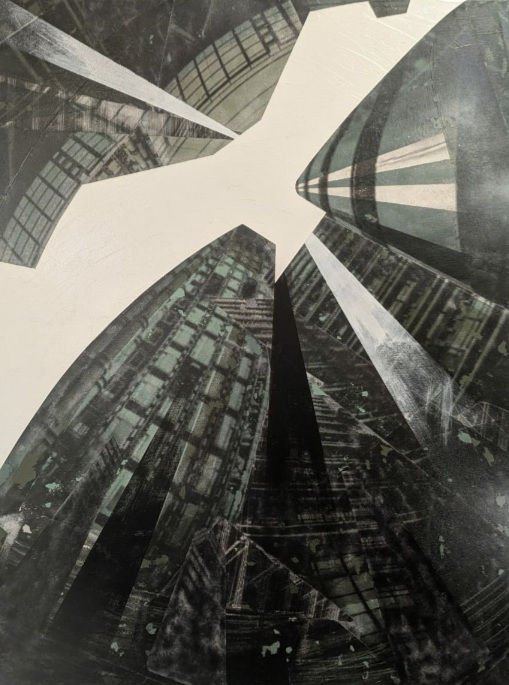
THE ENGINE ROOM III
OIL PAINT, SPRAY PAINT, AND COLLAGE ON DEEP EDGE CANVAS // 80CM X 60CM.
processes can at times be abused by those in authority. For me the line between my ideas, and living a tutors dream (that they didn't get round to) was getting increasingly blurred.
Coventry University and UWE, Bristol were bollocks. I was a punk like that. So with all of that said, for me personally I feel my real cultural substratum was established when I actually left University in England, and set up my own studio in Antwerp, Belgium. In September 1999 I bagged my very first solo exhibition in Vorst Nationaal, Brussels (the largest indoor arena in that country). From that point I felt that I had finally found my own voice, and the work that was produced at that time still strongly resonates to my artistic research up to the present day.


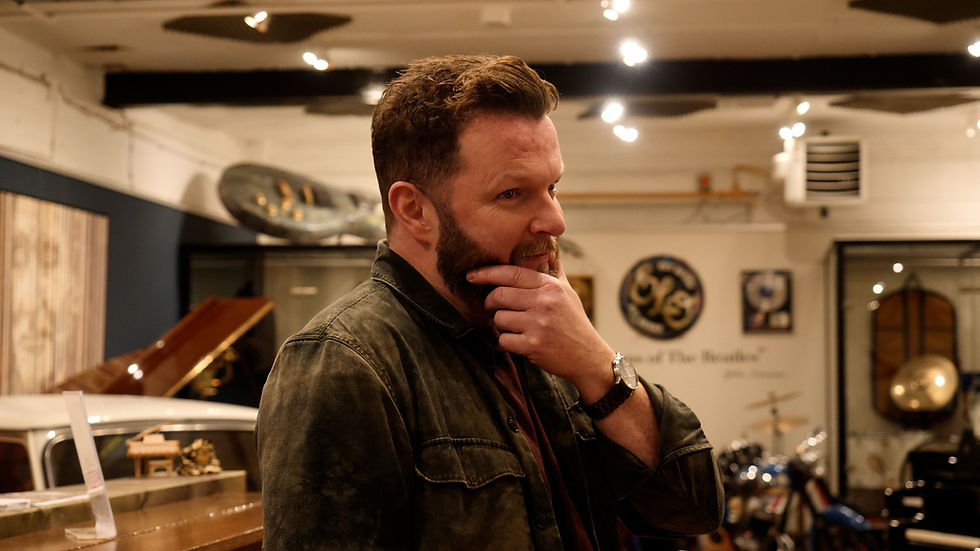
Damien McGinley at Sherwood Phoenix Music
Concepts can come from any avenue. For me influences can range from literature, music, and conversation, to something as arbitrary as walking down the street first thing in the morning. How do I develop my ideas?
A typical example of how I would approach the practical process on, say a standard canvas, would be after establishing the core composition - whether it be a freehand drawing, photograph, or press snippet - I would then map said imagery out directly on the canvas. In most cases I would deliberately bend, swerve and distort the composition at this point, to establish the overall feel of the piece I want to generate.
Then I begin the actual painting process, always starting with the skyline as the anchor for the composition. When I feel satisfied that I have generated the atmosphere I want to convey in that area of the frame ( and when it is suitably dry), I then tape off that facet of the work, and begin to oil paint, and hand blend collage into the street scenes.
A common assumption from audiences is that I use silkscreen printing in some of these areas. I do not. It is all paint and collage, by hand. The final process is to remove the sealed, taped off area, to reveal the skyline again. The fresh clean lines of that element act as a deliberate, stark counterpoint to the deeper, distorted grit that the collage and oil infuses into the street scene. Memories and everyday life experiences do indeed regularly throw fuel on the creative fire. The question reminds me, fondly, of when I was completing 10 pieces for a novel. I had worked hard on this project. In a cold studio in my hometown of Kerrykeel in Ireland I was finishing the last piece. It was the cover piece, of a crazed bomber who had been terrorising a city, walking away from an exploding building.
A dark, faustian figure, in a trilby hat, clutching a hankerchief to his face. That night I had finally finished the final piece, and did what every self-respecting artist should do - I went to the pub. Sitting over an ice cold beer however, I was still irked. I could not find a proper title for the piece. The project wasn't finished. Well, not until Mc Devitt the bartender spotted me (in my raggedy, paint splattered overalls) and declared "Look at you McGinley, all rags and ruin! " ....... and Eureka ... There was the title for the front cover piece. The project was finished.


Damien McGinley’s key solo exhibitions over the last number of years include ‘Intro’ (Brussels, Belgium 1999), ‘9th and Hennepin’ (Novi Sad, Serbia 2003), 'CCTV Blues' (Donegal, Ireland 2005), ‘Shadow Boxer’ (Berlin, Germany 2008), ‘Eurekastraat’ (Antwerp, Belgium 2012), ‘Hectic Eclectics’ (London, UK 2013), ‘Mirrorball' with sculptor Miodrag Peric (Antwerp, Belgium 2014), 'Excess Baggage', again with Peric (Paris, France 2016), ‘Kicking Tyres & Lighting Fires’ (Nottingham, UK 2017), 'Surface To Air part II' (Nottingham, UK 2018), ‘Fault Lines’ (Manchester, UK 2023), ‘Untergang’ with Nigel Addison (Nottingham, UK 2025), and ‘Fault Lines II’ (London, UK 2026). '(RE) Wired' Vienna, Austria 2026)
Collaborations include creating the artwork on several novels, photo journals, as well as album cover designs across Europe. He has also participated in a number of large collective exhibitions, most notably ‘De Keltische Tijger’ (Antwerp, Belgium 2003), ‘PC 100-Best Of’ (Berlin, Germany 2009), ‘80Q- Show Your Hope’ (global tour 2010-2012), 'ART 3F' Expo (Nice, France 2015), 'London Calling' (London, UK 2016), 'Arte e Collezionismo' (Florence, Italy 2017), ‘Catalystic Counterpoints’ (New York, USA 2017), ‘Enlighten’ (Enniskillen, Northern Ireland 2021), ‘Affordable Art Fair’ (Antwerp, Belgium 2024), ‘Hermione’ (Dublin, Ireland 2024) and the Manchester Art Fair (Manchester, UK 2025). 'The Hitman' in collaboration with Mr Phantom (London, UK 2026)

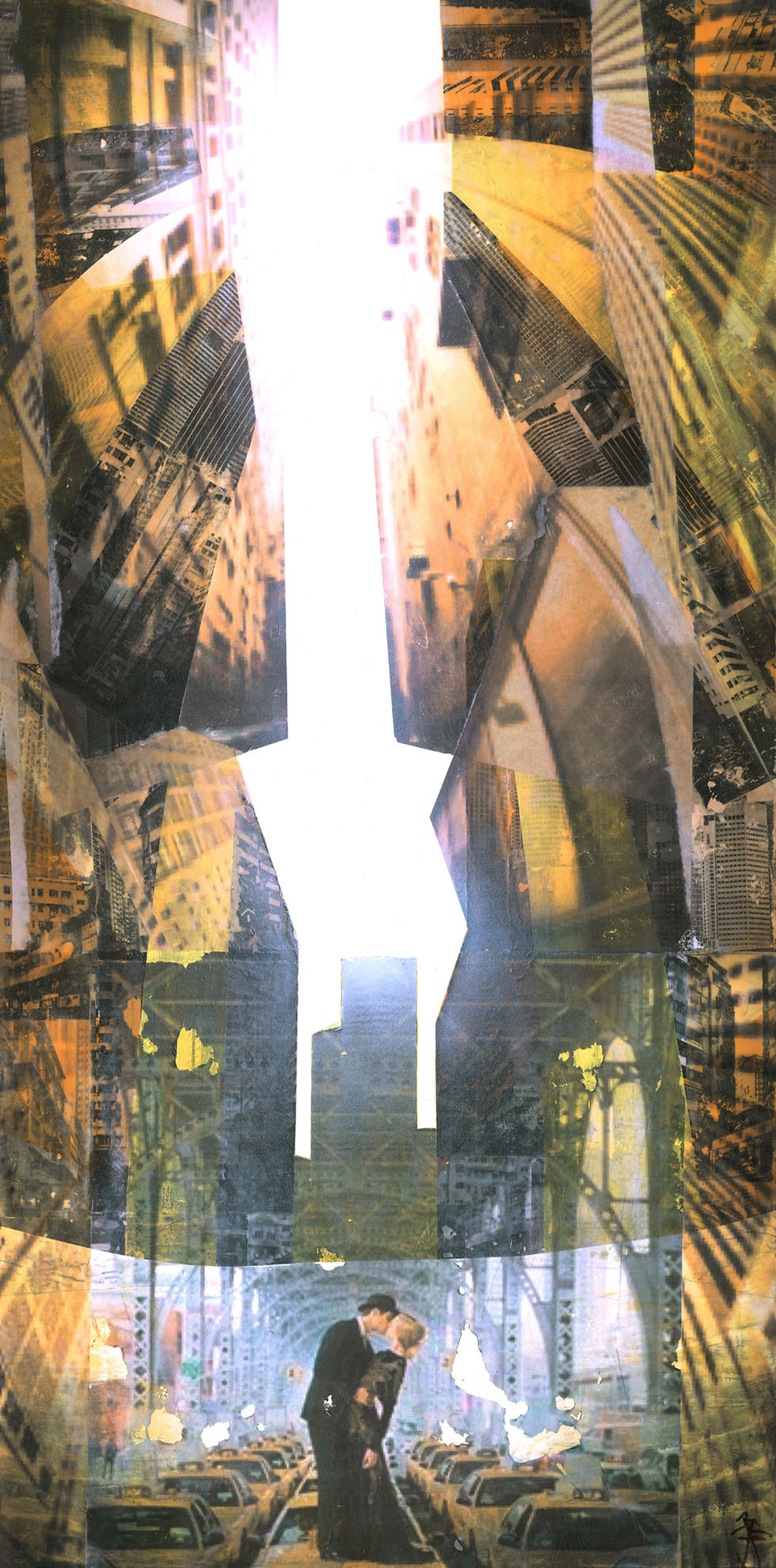_edited.jpg)
HOW YOUR HEART IS WIRED.
50cm x 100cm) Oil Paint, Collage, and Spray Paint on 4mm Oxidized Sheet Steel.

HOW YOUR HEART IS WIRED III
50cm x 100cm) Oil Paint, Collage, and Spray Paint on 4mm Oxidized Sheet Steel.

HOW YOUR HEART IS WIRED IV
50cm x 100cm) Oil Paint, Collage, and Spray Paint on 4mm Oxidized Sheet Steel.

HOW YOUR HEART IS REWIRED
50cm x 100cm) Oil Paint, Collage, and Spray Paint on 4mm Oxidized Sheet Steel.


McGinley has held the role of Artist In Residence in Prima Center (Berlin, Germany 2008), the Victor Vasarely Foundation (Marseille/Provence, France 2013), as well as the Irish Cultural Centre (London, UK 2026).
He also has works in permanent collections worldwide, including the Irish Embassy (Athens, Greece), Barbara Stanley Art (London, UK), Galerie Campo & Campo (Antwerp, Belgium), Hambly & Hambly Gallery (Northern Ireland), the National Gallery of Macedonia, the Irish State Art Collection, and the Siena Art Institute (Italy).
Prix Godecharles Finalist, Brussels 2001.
Culture Ireland Exhibitions Awards Winner 2008 & 2013.
Irish Embassy Awards Winner 2008 & 2019.
UK Arts Council Exhibitions Award Winner 2013.
In:Sight Finalist, UK 2016.
Official International Jury Selection - Florence Biennale 2019.
Official International Jury Selection - Osten Biennial of Drawing, Skopje 2020.


